Writing has long been known to be an effective means of processing difficult things. Journaling is most often recommended as a way of externalizing inward feelings and thoughts. The use of creative writing is less utilized as a therapeutic method but almost every writing course, book, workshop I’ve been to talks about the emotional process of creative writing and often incorporates exercises to help the process which are on par with many exercises I use in therapy practice. Over the years I’ve begun to compile and re-creative creative writing exercises to be more explicitly therapeutic and therapy exercise into a creative writing process. The result has been, in my experience, a means of processing difficult emotions and mental health issues which leads to better, more descriptive, insightful and creative writing.
Poetry is intimidating to many but more and more are finding the carthartic effects of putting feelings and sensations to paper. The following exercise is designed to address issues related to body image. We are affected by social constructs of beauty, size, ability and aging and by illness, body changes due to surgery or accidents and changes in our own experience of body changes due to chronic pain, or other ongoing symptoms. There are many events that may influence our experience of being in our body and our feelings about our body.
“This exercise distills and contains the event. In doing so we may be able to better see the essence of the event and it’s impact. Self compassion often follows.
Start by writing, as succinctly as possible, a critical event that has affected your perspective of your body and your relationships with your body. Name what happened and how it impacted you.
Example: At the age of 18 I went on a trip with a group of 20 other young adults to central America for one month. We were given an anti-malaria medication to take for the duration of the trip. About 3 weeks into the trip I started experiencing strange symptoms, sudden weakness and occasionally hallucinations- lights in my periphery vision. Doctors in Central America assumed I was dehydrated, but their treatment did not change my symptoms. A doctor in the US thought the symptoms were related to the anti-malaria medication and instructed me to stop taking it and said the symptoms should clear up in a few weeks. Over the next two years the symptoms re-occurred randomly (although did seem aggravated by stress) for various lengths of time. Doctors I saw at the time, generally encouraged me to seek psychiatric help.
After two years, once the symptoms stopped, I stopped talking about them when giving a medical history until I met a doctor I trusted who told me her friend had had the same symptoms on the same medication and they had lasted a similar length of time.
10 years later my son was given a diagnosis of anencephaly and was still born. Tests concluded it was not genetic but a deficiency in folic acid in my system, even though I had taken folic acid in early pregnancy. My own internet research showed that the anti-malaria medication I took depletes folic acid levels in the body.
For much of my adult life I have avoided intense exercise for fear that my body will become ill or injured again. I have not felt that I could trust my body to function in a predictable way and have always felt hyper attuned to any sensation that appears out of the norm.
2. Omit detail that carries less force.
Example: At the age of 18 I went on a trip. I was given an anti-malaria medication to take for the duration of the trip. Part way into the trip I started experiencing sudden weakness and occasionally hallucinations- lights in my periphery vision. The first Doctor assumed I was dehydrated, but that treatment was not effective. The next doctor thought the symptoms were related to the medication and said the symptoms should clear up in a few weeks. The symptoms re-occurred randomly (although did seem aggravated by stress) for various lengths of time over the next two years. Subsequent doctors told me to see a psychiatrist.
Once the symptoms stopped, I stopped talking about them. until I met a doctor I trusted who told me her friend had had the same symptoms on the same medication for two years.
10 years later my first son was given a diagnosis of anencephaly as a result of depleted folic acid in my body. That medication has this effect.
Fear that my body will become ill or injured has led me to avoid intense exercise for much of my adult life and to fear any sensation that appears out of the norm.
3. Reduce to the most essential words.
Age 18, travelling
Anti-malaria medication
Weakness and halluciations
Doctor 1- probably dehydrated
Doctor 2- stop medication- this will pass shortly
Doctors 3++++ seek psychiatric help.
2 years later symptoms stop, still unknown
10 years later- stillbirth, anencephaly, depleted folic acid, reason unknown- internet says anti-malaria medication can do this.
Next 20 years, fear of illness or injury has led to hypervigilance and avoidance of strong sensations- such as exercise.
4. Use short lines. Keep sense descriptions (tactile, visual, auditory) where possible
Age 18, travelling
Anti-malaria medication-warning, may cause blindness if taken long term
Legs give out, feels like I’m falling even when I’m lying down, hard to sense what is up. Eyes see lights that are not there.
Doctor 1- probably dehydrated
Doctor 2- stop medication- this will pass shortly
Doctors 3++++ seek psychiatric help.
2 years later -symptoms stop, don’t talk, no one knows or understand. Maybe I was crazy
10 years later- son stillborn, anencephaly, depleted folic acid, my body doesn’t work
Not genetic- internet says anti-malaria medication no longer on the market, may deplete folic acid
20 years – fear of illness or injury, feel panicky when short of breath, feel ragey when body is pushed to discomfort like I’m in danger and need to fight to protect myself
5. Change the tense if it’s awkward form present to past or vice versa. Consider whether to use first, second or third person.
Age 18, travelling
Anti-malaria medication
Weakness and halluciations
Doctor 1- probably dehydrated
Doctor 2- stop medication- this will pass shortly
Doctors 3++++ seek psychiatric help.
2 years later symptoms stop, still unknown
10 years later- stillbirth, anencephaly, depleted folic acid, reason unknown- internet says anti-malaria medication can do this.
Next 20 years, fear of illness or injury has led to hypervigilance and avoidance of strong sensations- such as exercise.
6. Stop when the poem feels complete even if the event is not complete.
7. Leave out parts if you feel they don’t belong.
FINAL VERSION:
Reaction
by Joy Eidse
18 years young, out for adventure, Costa Rica, Panama
Anti-malaria medication-warning, may cause blindness if taken long term
3 weeks later, legs give out, feels like I’m falling even when I’m lying down, hard to sense which way is up. Seeing lights that are not there.
Doctor 1- probably dehydrated
Doctor 2- stop medication- this will pass shortly
Doctors 3++++ seek psychiatric help
2 years later -symptoms stop. Maybe I was crazy.
10 years later- son stillborn, anencephaly.,
My body doesn’t work.
Tests conclude it is not genetic. Result of depleted levels of folic acid in my body.
Internet says anti-malaria medication no longer on the market, ‘may deplete folic acid.’
20 years of fight or flight response to physical discomfort.
I cannot trust my body
Age 50, hot yoga, mindful, gentle, tearful reconnection with the body.
No longer afraid.
8. Notice what becomes clear to you when you read the final version of this poem. What might change about how you now respond to your body when you experience the thoughts, behaviors or feelings associated with or affected by this event? How do you feel about the person that experienced these events now?
Example- I was SO young! My oldest son is older now than I was then. The repercussions were so far reaching. My fight flight response was not rational but made sense because of the long period of time not knowing what caused this and the stillbirth that followed. Now I have started doing more mindful exercise and hot yoga and am able to be more gentle with myself when I feel panic coming up. It makes sense that these mindful practices have been the most effective in helping me connect with my body and move past my phobia of intense sensations I feel a lot of compassion for my younger self and all the years I carried this fear of my body.
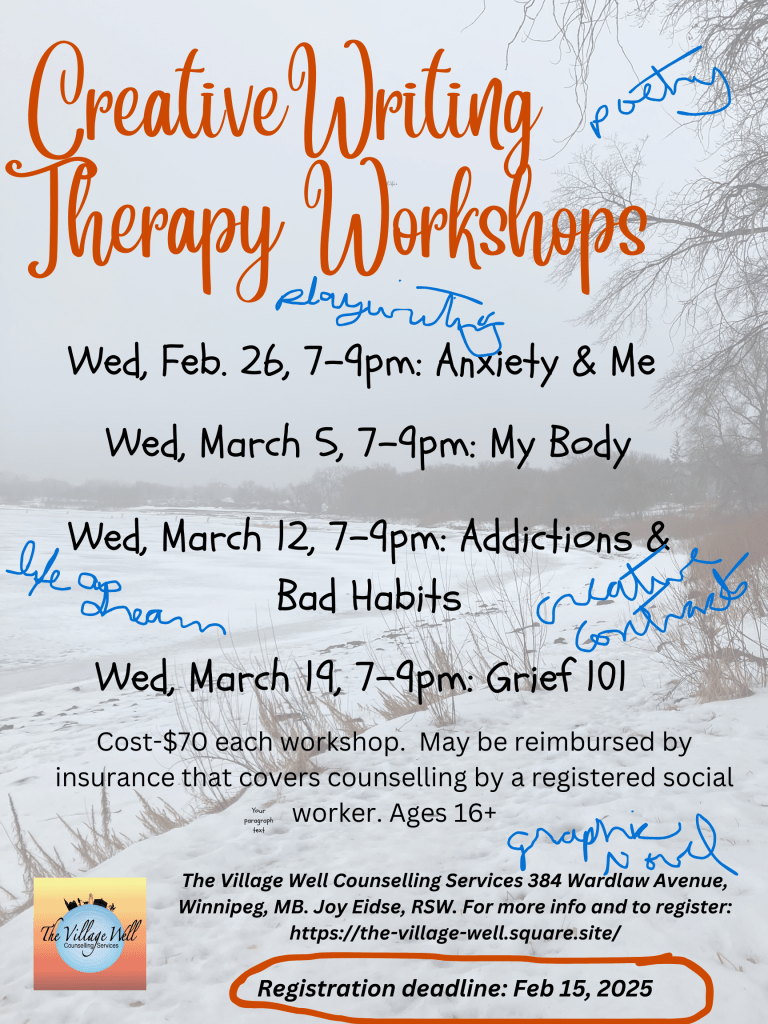
For more creative writing therapy exercises, check out my workshops coming in February 2025.

 It's Not Just You
Pingback: Life As a Dream-Creative Writing Exercise | It's Not Just You
Pingback: Memoir Writing to Heal- Life as Fiction, | It's Not Just You